
Ever thought that your child’s first classroom decision is more than just choosing the right school? This decision is crucial because it will shape their tomorrow. Choosing between a preschool and a kindergarten will help them learn, connect, and develop the right way for years to come.
If you have ever felt confused about making the right choice, you are in the right place. This guide is here to help you understand the key differences between choosing a preschool and a kindergarten for your child.
Our journey to understand the difference between preschool and kindergarten actually begins from this point.
When first-time parents are exploring schooling options, understanding what preschool is becomes essential. Early childhood education begins with enrolling your child in a preschool. If your child is between the ages of 2 and 4 years, preschool is designed for him. It is a place where your children get their first-ever outside-the-home experience. Preschool helps your child to see the world with a different eye. Along with the learning journey, admission to a preschool helps the child transition to a new world. The first few days of separation from parents while commuting to preschool might be painful for a few kids.
You should consider a preschool as an environment that conditions the mind and body of the child and prepares them for a new academic journey. Being a part of a preschool is never about teaching textbooks or formal lessons. It is about focusing on play-based learning that children love the most.
Preschool is an awesome place where caring teachers use activities like storytelling, art, music, and group play to educate children. Children away from home get the first-hand experience necessary for the development of their social skills. They learn the importance of sharing, cooperation, and teamwork. A preschool ensures an improvement in the child’s communication and emotional expression, which is actually a significant milestone.
Preschools cast their charm by creating a safe and nurturing environment for children. Here, they slowly adjust to being away from their homes and parents. This new yet caring environment builds confidence and independence in them, setting the right stages for future learning.
Over to the next stage called Kindergarten, where your child will achieve their succeeding milestones. The kindergarten is the place where learning evolves each day to help your child actually begin his learning journey. Kindergarten is like a bridge between preschool and formal schooling, where children aged 4 to 6 years enroll.
While the preschool adopts a play-based learning approach, kindergarten, on the other hand, follows a more structured and organized approach called the school readiness program. As this name suggests, a kindergarten prepares your child for their formal education. Children get to understand the basics of academics. It includes reading, writing, and remembering numbers. Most kindergartens have a well-designed early education curriculum. The core purpose of this curriculum is to prepare your child for primary school routines. Helping children follow instructions, complete tasks, and work independently, as well as being a team player, are essential segments of primary school routines.
While a kindergarten is way different than a preschool, its pattern of education often resembles a traditional school classroom learning. A closed observation will help the parents learn that a kindergarten comes with pre-defined schedules, planned lessons, and measurable learning outcomes for students. There is a core purpose attached to this format of education at kindergarten. This structured format enables any child to accept and adapt to the formal education system with courage and confidence.
Now that we have understood what preschool and kindergarten are, let’s have a glimpse of the preschool vs. kindergarten difference. These key differences will give you insights for making the right decision for your child.
Before we jump into the differences, it is essential to acknowledge the importance of both these stages as they serve individual purposes.
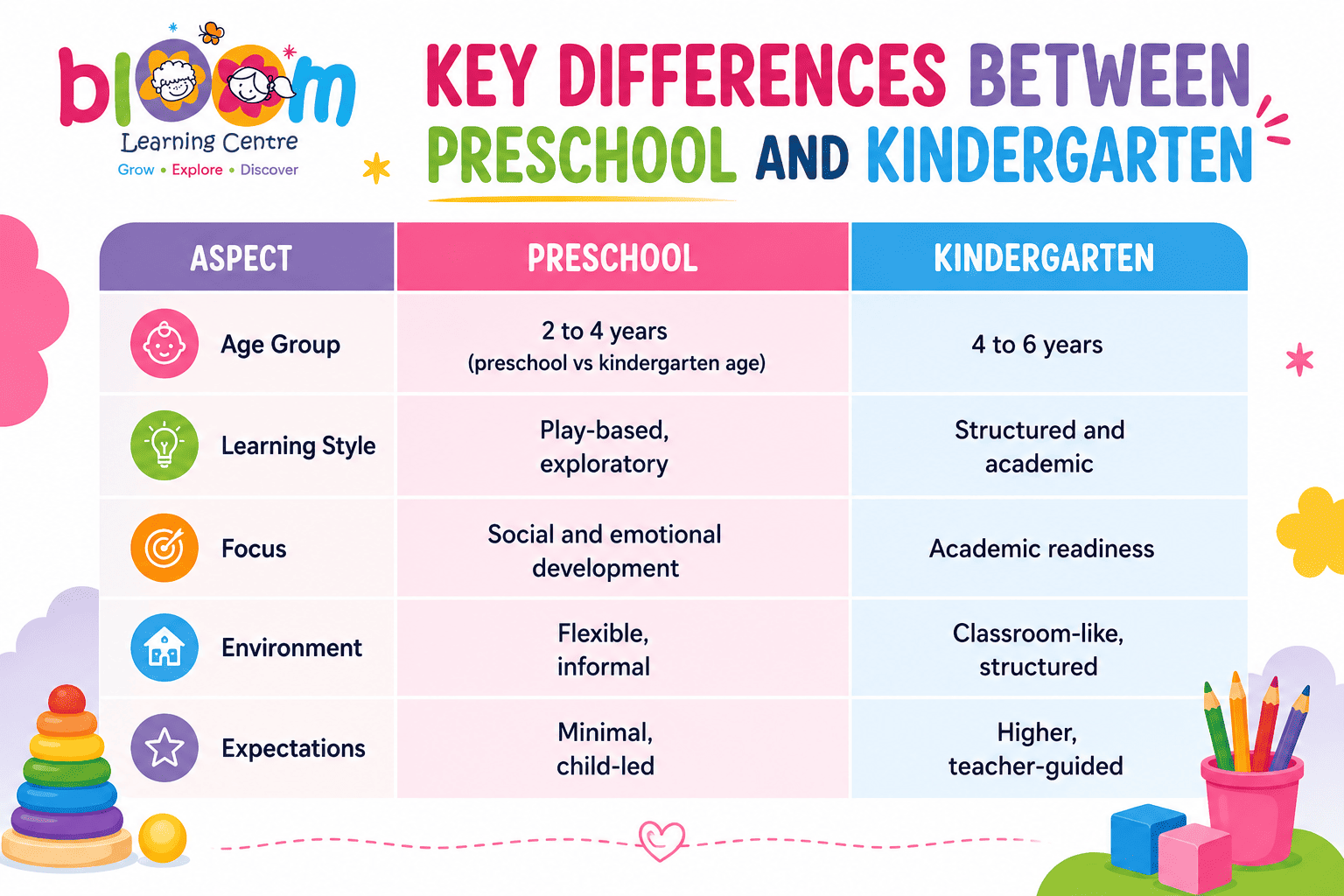
It's true that education is a deliverable commodity. While all learning types fall under the education umbrella, there is always a difference in the way the content is delivered.
Here, the real difference between preschool and kindergarten lies in the method of delivery. Because the purpose and method of learning delivery are different, the outcomes will be different too.
In simple words, you send your child to a preschool to build his foundational skills, and to a kindergarten to begin his formal schooling.
As discussed above, the noticeable contrast in the learning approach is essential. Parents mostly get confused when debating between play-based and structured learning. Honest advice to the parents would be to stay away from any such confusion, because both these teaching methods have their own importance, and they are interlinked.
The children's learning method at a preschool is about exploring the world around them through fun and play-based activities. Preschools educate children by doing things themselves, feeling objects through touch, closely observing the objects to remember their shapes, and interacting with teachers and other students to develop their social skills. What does the child earn through this approach? Your child achieves strong creativity, curiosity, and problem-solving skills, and that is precisely why you should enroll your child in a preschool.
When the child completes his tenure at the preschool, he is then ready for kindergarten. Just not physically, but mentally and psychologically, your child is all set to adapt to the structured early learning approach. Teachers at kindergarten introduce the child to organized learning methods through well-structured lessons, worksheets, and guided activities. They additionally learn to follow instructions, focus on tasks, and develop a disciplined mindset.
Honestly, one cannot replace a preschool with kindergarten or the other way round because both are important and both complement each other.
Think of your child’s academic journey as a structure. You always need a foundation to build the structure on. Likewise, a preschool offers play-based learning to build the academic foundation, whereas a kindergarten strengthens the child's academic trajectory through a structured learning approach.
So it is quite evident that both preschool and kindergarten are vital to properly develop and enhance children's development skills. It is the learning methodologies applied during these early years that build and blossom your child’s personality and learning habits.
Because preschool is meant to take care of the academic beginning, it focuses heavily on the social-emotional development of kids. Kids learn to name and express their feelings, interact properly with peers, and manage their emotions. Children do develop communication skills, but to a lesser extent. Similarly, they begin understanding basic problems and develop the ability to solve them, which is actually an awesome outcome of preschool learning.
Learning in kindergarten helps children take bigger strides, taking their skills to the next level. Their time invested in kindergarten ensures cognitive development in the early years. Logical thinking is an interesting talent that was never there during the preschool days. Because of the structured learning pedagogy, children start thinking logically. They now very well understand instructions from their teachers and parents and attempt to complete their tasks independently with confidence. Another important benefit of kindergarten training is the development of early literacy and numeracy skills, more numbers, and better mathematics.
Eliminating either of these stages is impossible, but creating a balanced path for the child’s academic development is what every parent must endeavor for. The child’s journey through preschool and kindergarten prepares him academically, emotionally, and socially as well.
Now that the significance of both these stages is well acknowledged, it’s time to choose between the two options. Before you jump to a conclusion, it will be a great idea to focus on your child’s needs.
Consider the following aspects before choosing preschool or kindergarten:
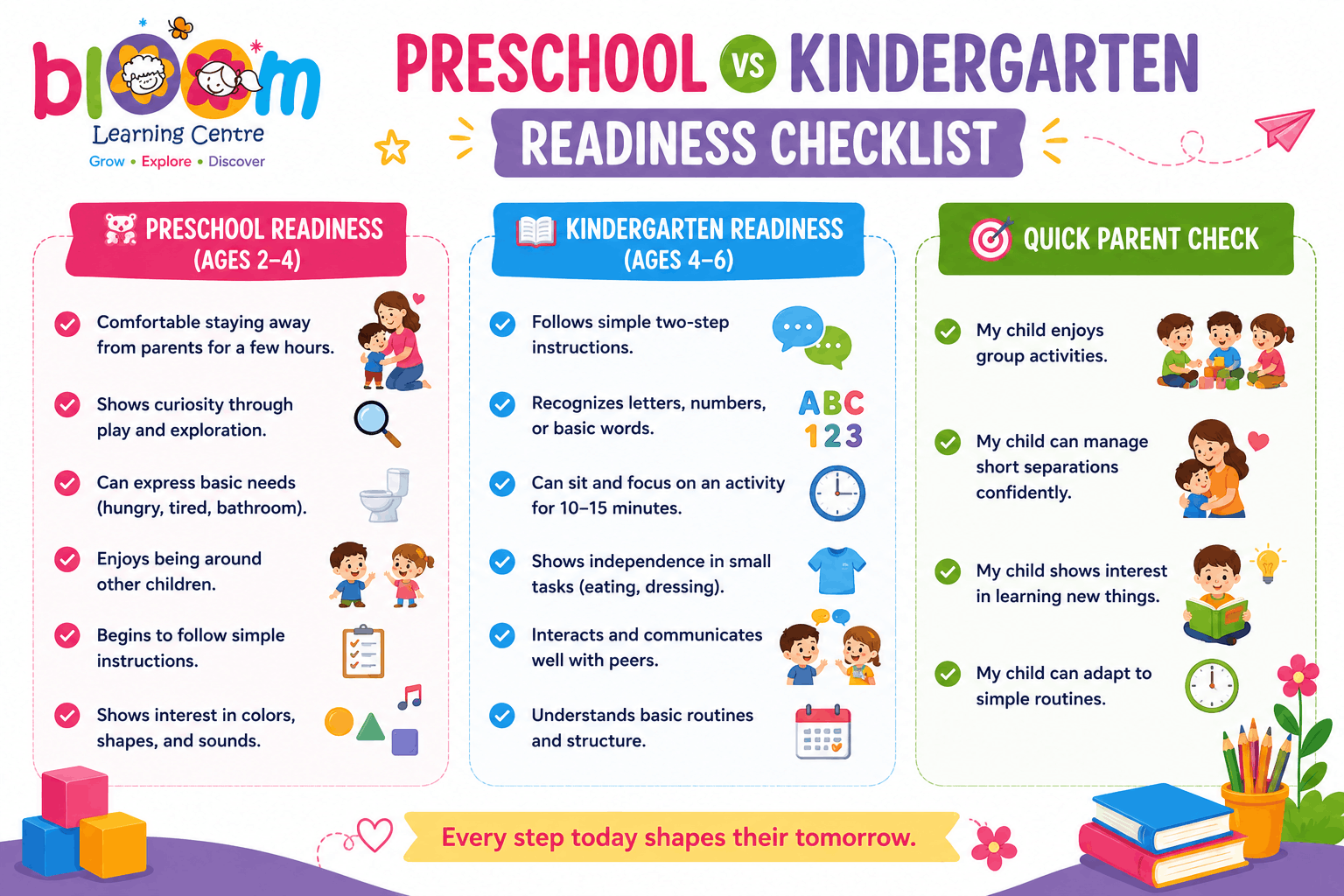
Every child is unique and develops at their own pace. Your goal shouldn’t be to rush through the stages. Instead, check your child’s comfort level and readiness to embark on his academic journey.
The above checklist will help you conclude whether your kid needs to go to preschool or is ready for kindergarten. If you study the above checklist closely, every sentence mentioned there is a signal for parents. Once you complete this checklist, you will have all the signs that your child is ready for kindergarten.
The above checklist is a more generalized one. Because every child is unique and different, parents must also consider the following indicators/questions to make a more accurate decision:
Every eligible child should demonstrate these kindergarten readiness skills. If your child does, congratulations, he is more than ready to become a part of a more structured learning environment.
Similar Blog: Preparing Your Toddler For Preschool: Is Your Child Ready?
One cannot reach the top floor of a building without stepping through or passing through the lower floors. Life is about beginning small and then making it big. To resolve their confusion, parents must accept both these stages as an integral part of their child’s academic journey by understanding the importance of preschool and the benefits of kindergarten.
Becoming a part of a preschool helps the child build their foundation by developing social, emotional, and communication skills. Kindergarten is there to help your child take bigger strides by building on that foundation through academics and a structured learning approach.
Ignoring any one of them may result in a mishap because their combination forms the backbone of early childhood education. Just as a preschool prepares your kid for kindergarten, a kindergarten makes sure that the child is all set to gain knowledge at the primary school and beyond. It isn’t a good idea to skip any of the stages because it creates gaps in development, and these gaps may hinder your child’s learning capabilities in the long term.
Choosing the right early learning environment is one of the most important decisions you will make as a parent. At Bloom Learning Centre, we understand what children need during their formative years.
As a trusted preschool in Cayman, we provide a safe, nurturing space where children feel secure, valued, and encouraged to explore. Our experienced educators focus on holistic development, combining emotional care with age-appropriate learning.
Whether you are looking for a nursery and preschool in Cayman or a reliable early learning program in Cayman, Bloom offers programs designed to support every stage of your child’s growth. From sensory-rich environments to structured readiness programs, we prepare children to step confidently into formal education.
Give your child a strong start that lasts a lifetime. Contact us today to book your tour. Let’s meet to help your child embark on his new learning journey.
Preschool focuses on play-based learning and developing social skills, while kindergarten acclimatizes your kid to structured academics and school routines.
Ages between 2 and 4 years are considered ideal to start preschool for your child. It also depends on the child’s readiness.
While not mandatory, preschool helps children develop essential social and emotional skills needed for kindergarten.
It would be desirable if your child understands basic communication, follows instructions, has simple literacy skills, and can socially interact with others.
Look for signs like independence, attention span, and the ability to interact with peers and follow directions.
It is a method where children learn through activities like games, storytelling, and creative play instead of formal teaching.
Yes, but it may make the transition harder if the child lacks social or emotional readiness.
It builds the foundation for learning, behavior, and health, shaping a child’s future success.