
It is hard to guess what interests your child most unless you let him choose from the available options. That's how you discover his likes and inclinations. One fine day, you may see him making a tunnel from a cardboard box, imagining his spoon as a drumstick, and a small puddle becoming his tiny science laboratory. Even if your child hasn't developed any skills, he still will be a natural observer, tester, builder, comparer, and questioner.
Did you know that children already think like Little scientists and engineers?
STEM is a unique term that stands for Science, Technology, Engineering, and Mathematics.
"But why should my baby learn such heavy subjects? He still needs to grow before learning these heavy subjects."
If this is the question you have, then you don't need to worry because STEM is not a collection of difficult school subjects. Instead, it's an enjoyable way to explore how things work in the real world. Without heavy equipment or apparatus, you can still conduct simple STEM activities for toddlers at home. Surprisingly, you need water, paper, blocks, cups, leaves, or other familiar objects to begin these activities at home. Doesn't that sound like a close-to-zero-investment scheme?
Parents can use STEM to create enriching early childhood learning experiences. Children unknowingly use several skills at once, as they listen, speak, grasp, pour, count, imagine, cooperate, and solve small problems with guided efforts. All it takes is proper planning and the right approach to have STEM for preschoolers teach children important life lessons. Keep the excitement alive by allowing your child to find answers for himself.
Wondering whether your little one is prepared for preschool? Preparing Your Toddler for Preschool: Is Your Child Ready? explores key physical, emotional, social, language, and self-help milestones while offering practical guidance for a confident, positive transition.
When you look around and observe closely, everything happening naturally has science at its base. Don't treat science as just a subject. Science is nature's way of communicating with us.
Your child switches to "The Scientist Mode" when he looks around, notices something, and then wonders, “What will happen?” If your child demonstrates something similar, it's time to transform his question into playful science activities for preschoolers.
Take a medium-sized glass bowl and fill it with water. Now, add a few drops of two different food colors to that water. Ask your child to watch closely as the two colors merge into a new color. The child feels amazed and happy, and that's your bonus. Explain the whole process so he understands what actually happened.
If you want your child to understand the concept of weight, begin by placing a leaf, stone, cork, spoon, and plastic lid beside a bowl of water. Now ask your child to predict what happens next: From all the objects placed near the bowl, which object will float and which will sink? Ask him why he chose that answer. The next step is simple: test each guess.
Do you remember Mr. Bean? His innovative ways made him a legend.
Growing a bean is a simple experiment for kids.
When you want your child to learn about surfaces through touch, the Game of Texture Hunt becomes worthwhile. Invite your child to play the Texture Hunt game. Ask him to go around the house and even in the garden or backyard, if you have one, to find objects that are smooth, rough, soft, hard, or bumpy. Explain to him the difference between these surfaces through touch.
Hands-on science learning has great value in your child's life, and it can start with simple conversation. Ask him questions like, “What do you notice?" "Why did that happen?" and "What could we try next?" These questions spark curiosity, ignite creativity, and make their thinking more scientific and technical.
If tall buildings, beautiful bridges, and elegant houses amaze your kid, it shows his inclination toward engineering. Every tower that showcases its elegance captures your child’s attention and interests. Every bridge that bends, curves, and slopes sparks new curiosity and creativity in their minds. Enhance their imagination with beautiful blocks, cartons, paper tubes, tapes, and cardboard. You can buy these materials at your neighborhood store for kids' engineering activities.
You can buy a block game for your kid and challenge him to build a tower using these blocks. How high can your child build before the tower becomes unstable and falls? Teach him that a wider base supports a taller structure. Be by his side when he tries wider blocks at the bottom or compares different shapes.
Try a different approach. Place two books a short distance apart. Invite your kid to build a cardboard bridge that can hold his toy car. Draw a river on white paper and place it under the cardboard bridge. If the car falls in the river, then his bridge is weak. The main purpose behind these building activities for preschoolers is to introduce them to the concept of balance, strength, height, structure, and stability in simple terms.
Not everything needs to be perfect in life. Hence, parents should resist the temptation to repair every design. Ask your child, “What made the bridge or tower fall?” or “How can we make your bridge stronger?” These are not just questions. They build your child's creative problem-solving skills.
You can bring home a few creative games like these. When your child plays those games with his friends, he learns to share materials, explain ideas, and become a team player.
Help your toddler build confidence, friendships, and essential life skills through joyful everyday play. How to Encourage Socialization and Play in Toddlers Shares practical ideas for supportive spaces, age-appropriate activities, outdoor adventures, and handling common social challenges.
Math isn't as boring as most people call it. Math can be fun and meaningful when parents make it tangible instead of a dry subject. Children love things that they can touch and feel.
Design simple math activities for toddlers that he can play throughout the day. Counting socks, napkins, and towels while folding laundry is an interesting activity that kids enjoy. Ask him to sort bottle caps by color and match lids to their appropriate containers. Give him a mixed set of spoons. Ask him to arrange the spoons in pairs of two. Your kid can compare two spoons and decide which is longer. You can help your child arrange these spoons in ascending or descending order.
Supper time in the evening is great for a math activity. Cut the fruit into similar-sized pieces, then ask your child to count them. Once he finishes counting, ask him to divide the fruit pieces equally between two plates. Then ask whether both plates have the same number of fruit pieces.
Make cleaning fun by turning it into counting games for preschoolers. For example, ask, "Can you put five blocks in the basket?" instead of just reciting numbers. During kitchen time, encourage your child to scoop three spoonfuls of flour and empty them into a dish. While walking, find and point out repeating patterns. Let children look around for such similarities.
These small experiences strengthen early math skills. Children quickly learn number sense, sorting, measurement, comparison, shape recognition, and pattern awareness. When with kids, always keep your mood playful. If your child loses interest or feels bored, stop and return home. You can resume this activity on another day. Positive experiences and number experiments matter more than getting perfect answers. Make sure that your child feels happy, joyful, and stress-free by the end of this activity.
A common question we receive is whether a STEM activity inspires curiosity and critical thinking in children.
In most cases, the answer is yes, as long as the STEM activity interests the child. Because he's interested in the activity, the child wonders and tries again until he succeeds. That's the beauty of a STEM activity. When children take part in a STEM activity at home, they naturally develop critical thinking skills. This happens because children get time to examine a task, think, analyze the situation, and then decide on the next step. Parents must wait before stepping in. Give your child the freedom to see the situation in their own way.
Did you see that the paper boat sank? What could be the reason? How can you make it float longer? These questions will make your kid curious, think for a while, and inspire them to find answers. Puzzles are best for sharpening their brains and raising their IQs. When a puzzle piece doesn't fit, encourage your child to rotate it or try another side. Whenever an ice cube is exposed to heat or even normal room temperature, it begins to melt. Ask your child where the water came from. Such moments are precious. They not only inspire but also deepen children's curiosity.
Parents shouldn't solve problems for their children; instead, they should support them by enhancing their problem-solving skills. They should follow a simple rhythm.
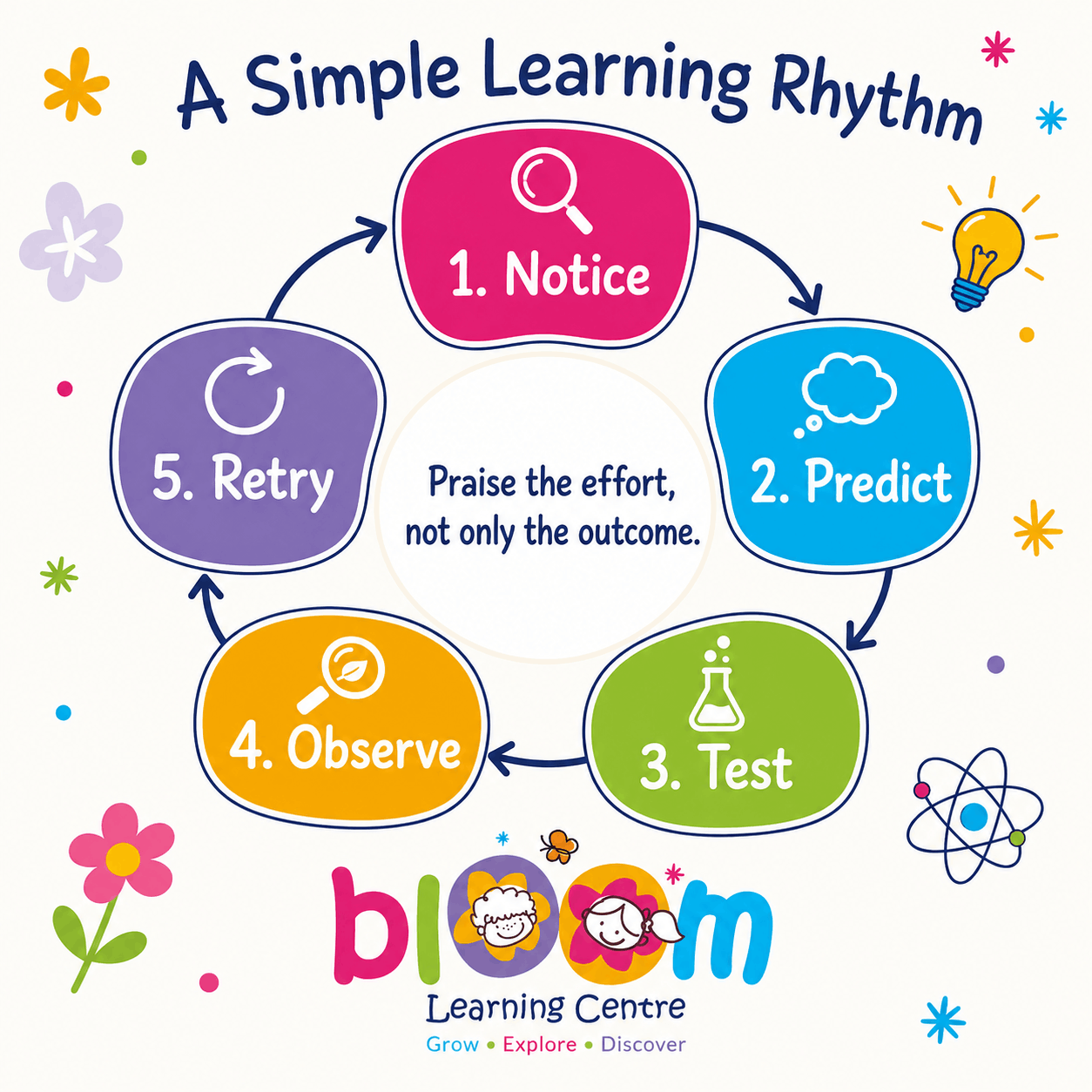
Outcomes aren't as important as effort. So, praise your child's efforts with words that inspire him.
Each activity isn't a test but a learning experience for a better tomorrow. Mistakes shouldn't attract punishments. On the contrary, they are strong clues to help children choose their next step more cautiously.
Almost every household has a recycling box for items they no longer need. Are the items in this recycling box truly useless? In fact, some of the best DIY STEM activities begin with items from this recycling box.
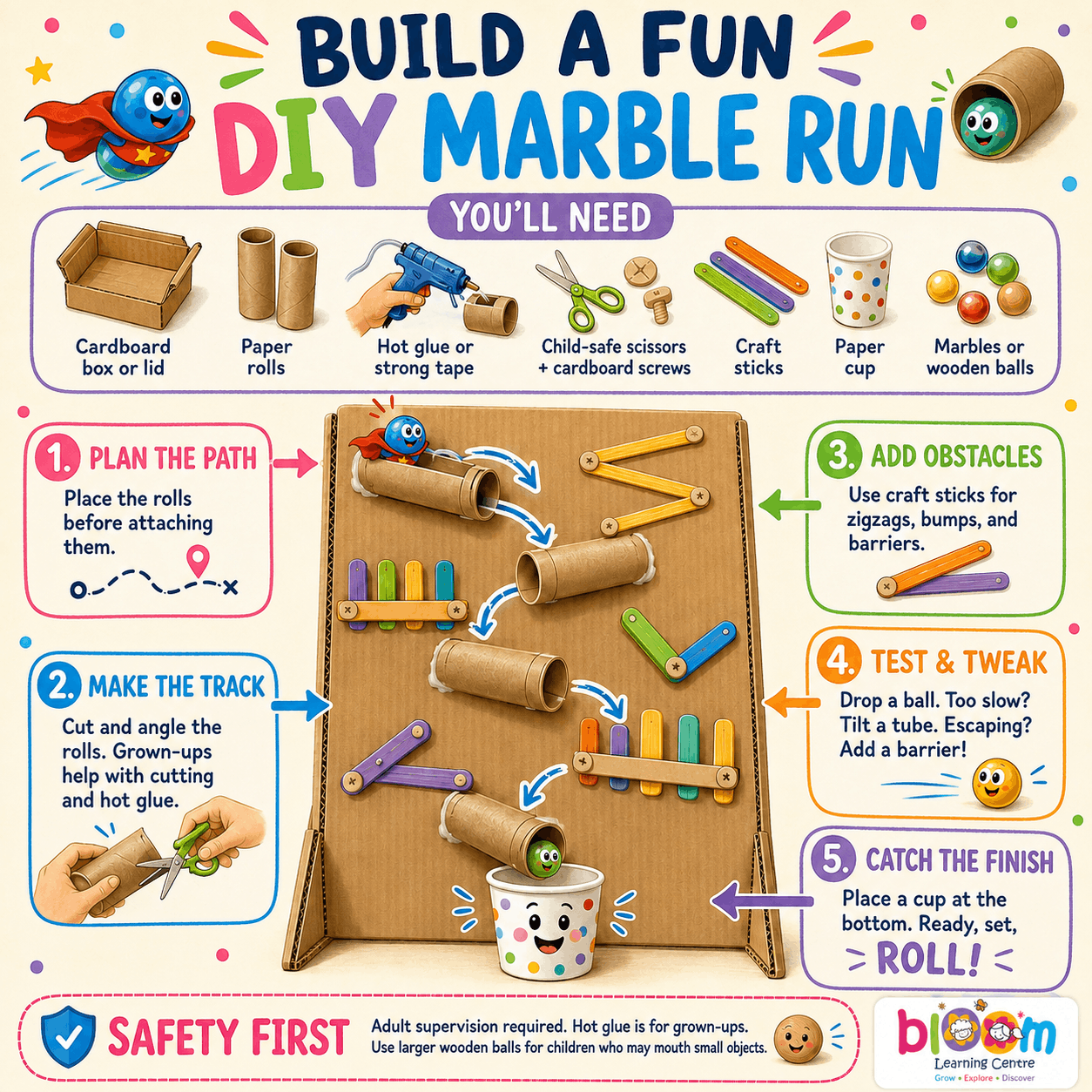
A plain sheet of paper can very well become an airplane, ramp, fan, or bridge. Cups can be stacked, sorted, filled, and compared, each action giving a unique lesson to learn for your child. Gently strike your spoons against safe surfaces to enjoy different sounds. We keep receiving cardboard boxes from food delivery partners and online shopping platforms along with the products we order. Help your kid convert those cardboard boxes into beautiful houses, tunnels for toy trains, and vehicles. Older preschoolers can try a DIY marble run under close adult supervision. Smart usage delivers smart products.
For easy STEM projects at home, build a cardboard ramp and test which toy rolls the farthest. Create a tower from folded paper. Make a rain gauge from a clear container and mark the water level after rainfall. Explore melting by placing ice cubes in warm water.
These affordable learning activities show that creativity doesn't require expensive equipment. Avoid sharp edges, small parts, hot liquids, glass, and unsupervised water play.
STEM play is more about life-centered development than pure academic learning. STEM teaches skills that help children throughout their lives. Pouring water, picking up blocks, folding paper, and placing small items are essential activities that enhance coordination and fine motor control in children.
When you ask your child to describe his observation, he takes time to collect his thoughts, ideas, and views about what he saw. Once he's done, he begins describing his observations without realizing this activity is building his vocabulary and communication skills. STEM activities strengthen focus, improve attention, and boost memory, supporting strong cognitive development in children.
Collaborative, teamwork-based child development activities teach patience. Children learn to take turns and connect with other students. Rebuilding a collapsed tower, bridge, or structure builds your child's emotional resilience. He learns to accept failure. When he completes a challenge after several unsuccessful attempts, he understands the importance of hard work and self-confidence.
Most importantly, learning through play allows children to feel ownership of their discoveries. STEM education also encourages them to become adaptable thinkers. With STEM training, children communicate effectively, face challenges with confidence, and approach new situations with curiosity. STEM activities form the basis of your child's overall development.
STEM activities aren't a one-time activity but an ongoing learning process for children. You don't need to schedule a formal lesson every day. Instead, use meaningful family learning activities that arise from everyday routines. Show your child how butter melts as you heat it in a pan. Show him how the flour looks and feels, and ask him to touch the dough and compare the change in its texture and smoothness.
Gardening is another STEM activity where children can compare seeds, count petals, observe insects, and measure plant growth.
During a trip to the supermarket, ask your kid to sort vegetables by color, read the weight on each packet, compare package sizes, and count the total items you kept in the basket.
Make STEM learning at home part of household tasks. Place multiple containers of different capacities and ask your child which container will hold more water. Teach your child to sort clothes before washing, and let him do so whenever time permits. Show him two items with different weights and ask him where the heavier item should go in a bag. These practical activities and questions offer visible results and clear learning outcomes.
Make sure educational activities feel like shared adventures, not assignments. While teaching, observe your child's interests. Children get bored easily, so keep sessions short and informative. Always celebrate their questions and doubts.
Looking for fresh ways to make family weekends meaningful and memorable? Fun Activities You Can Do on a Weekend with Kids shares inspiring ideas for outdoor adventures, creative indoor play, science experiments, nature exploration, and quality time together.
Create a "Family Wonder Jar." Explore one question each weekend.
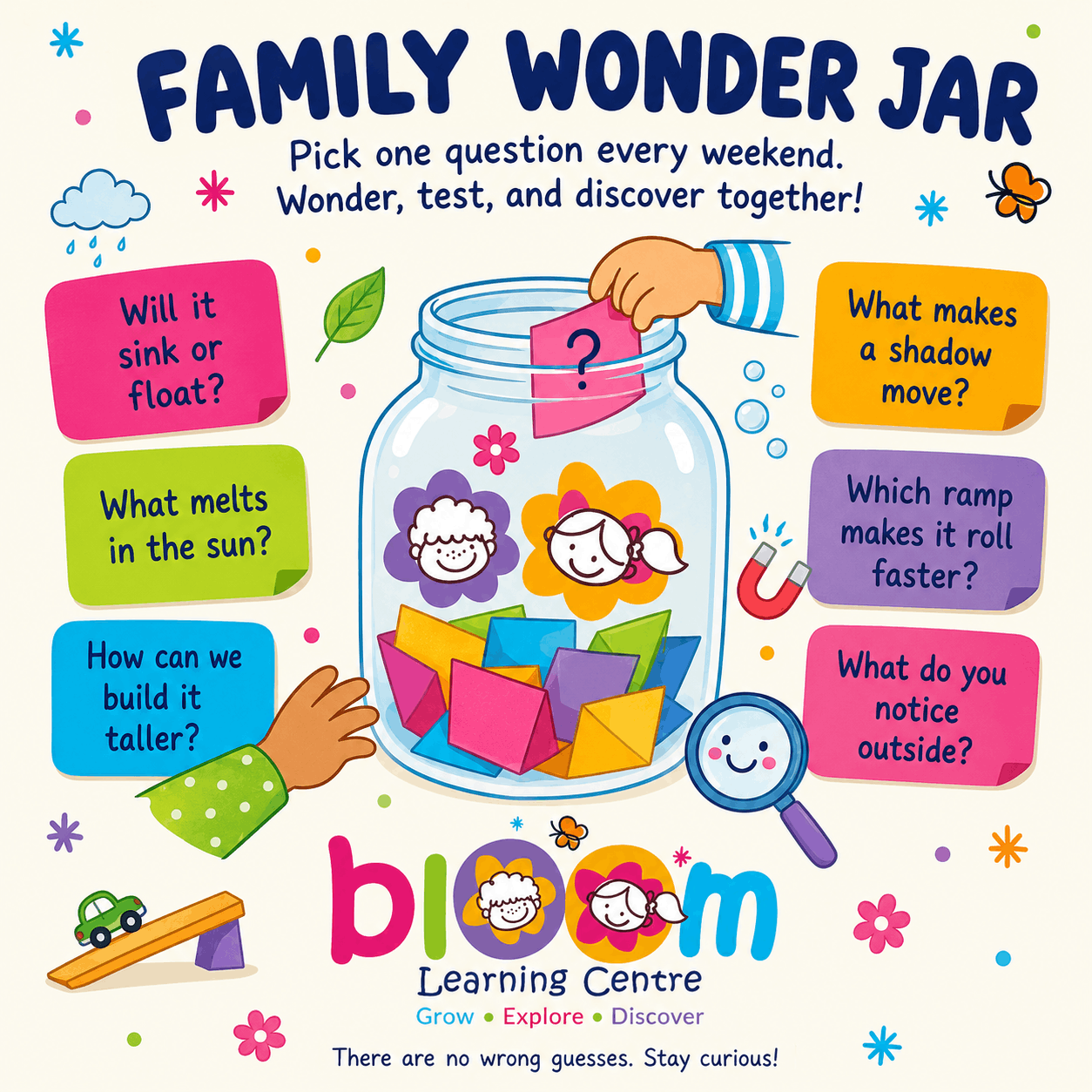
At Bloom Learning Centre, we understand that young children learn best when they can move, touch, ask questions, imagine, and create. Our approach to STEM learning for preschoolers turns age-appropriate concepts into enjoyable experiences that feel natural to curious minds.
Children enjoy science experiments, sensory exploration, counting games, construction challenges, and problem-solving tasks. Our educators ask thoughtful questions and give children space to test their ideas. This fosters creativity, confidence, communication, and independent thinking.
Our early childhood education programs recognize that each child explores at a different pace. Activities are designed to support development without taking the joy out of learning.
Looking for a fun, engaging environment where your child can learn through exploration? At Bloom Learning Centre, we blend play, creativity, and STEM-based activities to help toddlers and preschoolers build essential life skills and discover the joy of learning every day. Explore our programs and let your child's next big discovery begin at Bloom.
Conclusion: Small Experiments, Big Discoveries
You do not need to be a scientist, engineer, or teacher to support early STEM education. You only need to notice what interests your child and make space for safe exploration. A floating leaf, a falling tower, a repeating pattern, or a growing seed can open the door to an important idea.
Keep fun learning for kids simple, regular, and pressure-free. Ask questions, listen to unusual explanations, and celebrate the courage to try again. Over time, these playful moments can strengthen curiosity, creativity, confidence, and resilience.
The best STEM activities at home do more than explain how the world works. They show children that their questions matter and that they can find answers. One small experiment today may inspire a lifetime of discovery.