

Feeling safe and protected is essential for every child’s mental and physical growth. This feeling of being protected is so immense that children automatically become confident and well aware while exploring the world around them.
To make your child feel safe and prepare him for the world’s challenges, parents must teach their children about child safety awareness. This knowledge is not to frighten your kids, but to help them understand how people are around them. When children know how to judge a situation, they will be in a better position to listen to their instincts and act with prudence. Over time, they will grow stronger and more secure amidst strangers.
A practical approach to generating awareness will be to explain to them that some people are safe while others are not. This simple understanding of the ways of the world will build trust and deepen your child’s confidence as he learns how children should be safe. When you start teaching kids about strangers, you need to maintain the balance. It will be great if your child understands the basics without becoming anxious, overwhelmed, or overly cautious.
Let your child navigate this world with care, clarity, and confidence by making him understand what safety is and how it can be achieved.
When children understand people, they know safety.
Just because your child is too young, don’t doubt his intellect and common sense. Begin by explaining the meaning of stranger to kids in the simplest way. A few well-placed words are all you need to tell them, like, “a stranger is someone you do not know.” Do also emphasize that every stranger is bad or dangerous; some can be safe and supportive.
Tell your child that running away from an unknown person the moment you see them doesn’t make sense. There is a possibility that the stranger you are running away from or ignoring might be of great help to you. All it needs to ensure your safety is to stay calm, vigilant, aware, and alert. Teach your kid to remain polite without getting close or sharing your personal details.
Teach your kid a new and meaningful term: “This is called Cautious Friendliness.”
Where long lectures don’t help, explain who a stranger is to children by giving them daily-life examples that are simple to understand and remember.
Parent-Approved Adults, yet another term that parents should teach and highlight that those strangers whom your parents approve are safe, while everyone else is someone you must stay away from and be aware of. Teaching about stranger awareness for kids is one of the most essential life lessons that parents must teach their toddlers without creating unnecessary fear.
Awareness protects a child more while fear shatters his confidence.
It is more than essential to make your kids understand the actual difference between Safe Strangers and Unsafe Strangers.
Here is a list of safe strangers that your kids should know.
Safe helpers are trained professionals who make children feel secure. These people, through their actions, help kids understand the difference between safe strangers and unsafe strangers, and also play a vital role in teaching kids about safe helpers to count on during exigencies.
Teach your child to trust their “body alarm.” A body alarm is a signal that your body gives you when it feels that there is something that’s not right. In most cases, it is probably true, and the child must believe his body alarm signals without delay.
This body alarm mechanism enables your kid to identify safe strangers and helps them remember Child Stranger Danger Safety Tips. Trusting their body instincts, a natural impulse, will aid your child in safeguarding themselves from unsafe people and situations.
A safe person makes your child feel secure; an unsafe one makes them feel unsure.
It is the responsibility of every parent to make their child aware of the simple rules mentioned below. Knowing these rules helps children stay vigilant and act with confidence. You must explain these child safety rules in an easy-to-understand way.
Teaching these safety rules for kids is not a one-time exercise. These rules should instead be taught on a daily basis to help children memorize them. Clarity is important when understanding rules. When you integrate them as a regular part of personal safety tips for children, your child will easily know what exactly they should do.
Ensure to make things simple and easy for your toddler because this world isn’t as easy as it seems.
Simple rules turn kids into smart, alert decision-makers.
You can’t be with your kid to guide them every time they are alone and away from you. Hence, you must educate your child to identify red flags early by teaching them the following points clearly:
Become cautious if,
These are the warning signs of unsafe people that kids must know. Additionally, teaching kids about body boundaries can support them in making the right decision.
Teach your kids to trust their body instincts and inner feelings because they are powerful guides to help them when they need them the most. If someone or something makes you feel strange, shaky, or uncomfortable, just move away from them. There is no harm in following your intuition when it comes to spotting unsafe behaviour.
If something feels wrong, it usually is.
Cyberspace is the most familiar place to find strangers, and it is close to impossible to differentiate the genuinely safe people from the unsafe ones.
Our digital world is filled with strangers; hence, make them aware of online safety for kids.
In the real world, we actually get to see the real people, whereas the online digital world allows fraudsters to fake themselves as someone else. This is, in reality, a great risk not only for kids but also for adults. With the popularity of social platforms, people have developed the habit of sharing their personal photos, videos, activities, and even locations in some instances.
When children reveal their personal information, like photos, home address, or school name, online, they automatically become vulnerable. Strangers online may pretend to be kids or trusted adults, and kids might easily be influenced by what they see or hear. Make sure to teach your child never to chat privately with unknown accounts. They should also be taught not to respond to suspicious messages. Tell your child never to accept friend requests or chat requests from strangers online.
Healthy communication with parents can help clear confusion and pave the path to safety. Hence, ask your child to keep their digital screens open (unlocked) and discuss daily online interactions. Parents should regularly check their child’s history or logs when they are online.
To ensure the child’s safety, build digital stranger safety and stronger Internet safety rules for children at home. This is an effective method for protecting kids online while maintaining online transparency and safety. Always teach your kids that they do not need to tell everything to the world.
Online safety is people safety, just in another form.
With the right knowledge, children gain strength, making them strong, confident, and resilient. This knowledge also equips them with what to do, how to do, when to do, and what not to do.
Teach them to,
These steps not only build child self-protection skills but also teach real-life safety tips for kids. Well-planned safety strategies for children can keep them strong and provide support during emergencies. These strategies also enable them to handle unexpected situations with calm, clarity, and confidence.
Prepared kids feel powerful, even in tough moments.
Anything explained using real-life examples delivers more value and makes understanding simpler and easier for kids. Hence, you too can use similar examples as the following to explain concepts to your child:
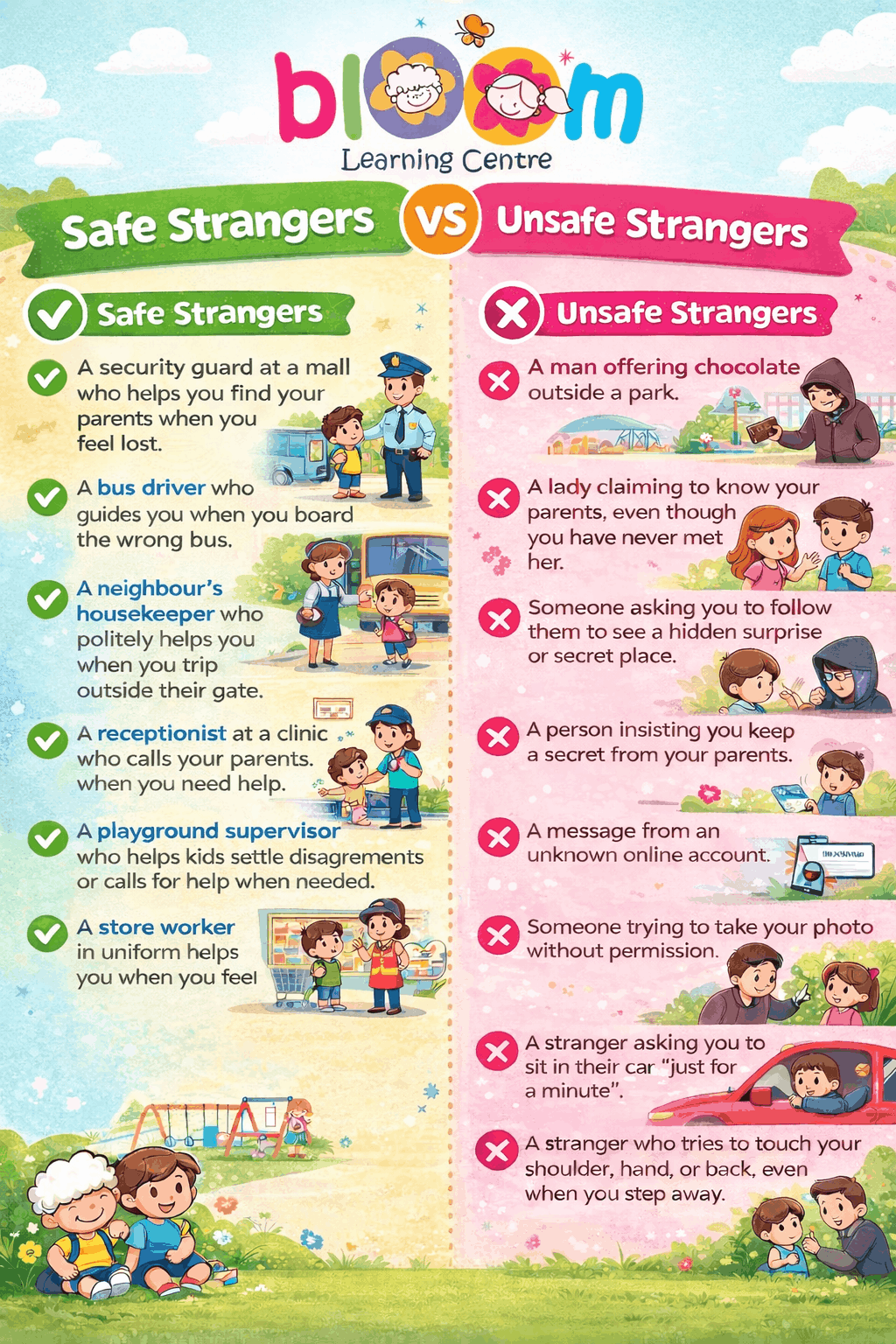
The above examples will help you walk your kid through the right steps. Teach your kid to say No, move away, seek help, and tell an adult when in trouble. These stranger danger examples help kids understand child safety scenarios and real safety situations for kids, making practical safety tips for kids easier to follow.
Practice builds confidence. Confidence builds safety.
Bloom Learning Centre plays an active role in helping children understand child safety in a calm, age-appropriate, and empowering way. As part of the Bloom Learning Centre safety program, self-safety is taught through real-life practice, simple language, and everyday routines. This helps children remember what to do without feeling scared or overwhelmed. The goal of this approach is to offer strong, gentle early childhood safety training that prepares kids for real-life challenges. Bloom’s methods work beautifully for local families looking for reliable preschool in Cayman.
Children learn best through imagination. Bloom uses role-play, puppet shows, and story circles to teach kids how to identify safe people, how to speak up, and when to seek help. These fun elements make child safety simple and memorable.
Teachers help children understand their internal feelings. Kids learn to notice when their bodies feel uncomfortable, tight, or confused and to treat those feelings as an early warning signal. This is a core part of the Bloom Learning Centre safety program because it teaches children to trust themselves.
Every child learns who their safe adults are, both at home and at school. This helps them know exactly whom to approach when they need help. It builds confidence early, which is essential in strong early childhood safety training.
Bloom teaches easy rules like “No–Go–Yell–Tell,” “Always stay where an adult can see you,” and “Never go anywhere without asking.” These rules are practised regularly so children can recall them instantly. This step brings structure to preschool safety education in Cayman, helping kids remember rules naturally.
Bloom focuses on staying calm and confident.
We teach children:
These skills support overall child safety and give children the ability to act wisely in real situations.
Gently, teachers introduce kids to the idea of digital strangers. They learn why sharing photos, names, or information online must be done only with parent approval. This step is now essential in modern preschool safety education in Cayman, preparing children for both offline and online worlds.
Whether it is practising how to respond when someone offers a gift, pretending to be lost in a public place, or learning how to ask for help from a safe stranger, Bloom gives children hands-on practice so their response becomes natural. These interactive drills strengthen the Bloom Learning Centre safety program and make learning fun.
Bloom creates a trusting environment where children feel safe reporting anything that makes them uncomfortable. Teachers listen, validate, and guide children without judgment. This helps kids take child safety seriously while knowing they always have supportive adults to talk to.
At Bloom, children don’t just learn rules. They understand the confidence to protect themselves.
Your kid needs to differentiate between safe and unsafe strangers and keep themselves safe from those who can harm them.
Teach your child to stay safe with the following steps:
This encourages raising confident kids, promotes child awareness and safety, and helps you keep children safe through consistent guidance. You raise confident, safe kids when safety becomes part of your daily routine.
Self-Empowerment is the strongest form of protection.
Parents must ensure that their child does not fear the world. The only thing kids must understand is that every lock has a key and every challenge a way out.
Giving the right guidance, developing safety habits, and maintaining awareness when alone will enable your child to face any situation with clarity, strength, and resilience.
A well-informed child is a well-protected child.
Kids can learn simple safety rules from age two or three. Keep it gentle, simple, short, and practical.
Never rush. Use calm words, share real-life examples, and focus on “smart choices” and the child’s empowerment, not danger.
Police officers, firefighters, teachers, and store workers with uniforms or badges are safe strangers to interact with.
Teach your kid to follow the “No–Go–Yell–Tell” strategy.
Say NO firmly.
GO away to a safe spot.
YELL loudly for help.
TELL a trusted adult what happened.
Bloom uses role-play, stories, daily practice, supportive teachers, and trained caregivers to make children’s safety simple, fear-free, and a top priority.