

If you are asked, "What is the best gift you can give to your child as parents?" What will be your answer? Take a moment to think. Is it unlimited love, comfort, or protection? No, these aren't the best gifts.
The three best gifts you can give are:
Parents often have the best intentions while helping their child excel in life. Unfortunately these intentions and their related actions might hold your kid back instead of helping them move forward. Do you want your child to lag?
While you wish and want the very best for your child, your efforts aren't measured by how much you do for your child, but by how well you equip him or prepare him for this harsh world that will never be gentle, predictable, or easy for him.
So the greatest act of love isn't in shielding him from the challenges, but strengthening his skills and capabilities to thrive independently without constantly depending on you.
Children are an extension of their parents; hence, filling their lives with immense love, care, and comfort is obvious. Parents always dream to see their child excel in life and become successful. Success cannot be defined by the child's academic achievements because success has a bigger and deeper reach than one can imagine.
Your role as parents isn't limited to preparing your kid for school or securing a brighter future for him. Your actual role is to mold your child into a thoughtful and strong human being who can contribute positively to his family, communities, culture, and the overall society.
Most parents feel that their children are here to fulfil their expectations and become their support system during old age. But these intentions are more selfish than they think.
Children actually deserve to be free. The freedom to discover their own selves, develop independent values, and pursue a purpose in life. Putting all these together will reflect who they truly are while making you feel proud of your nurturing. Allowing freedom to your child isn't as difficult as you feel. It is more about allowing your champion to think, question, and grow on his own. Your role is that of a mentor who helps shape confidence while transforming children into emotionally balanced and intellectually curious individuals.
While parents do everything in their power to offer the best life to their children, they unintentionally develop habits that slow down a child's development. A few habits, like constantly protecting them, making decisions on their behalf, or solving every problem, do not work in today's world. These habits may feel like responsible parenting today, but they can limit your child's confidence, independence, and emotional resilience tomorrow.
A change for good is always good for a change.
So, if you are eager to make those small changes to your parenting approach, let's explore five common parenting mistakes that most parents make. You will eventually understand why these mistakes happen and discover practical strategies to help children build a life where they can flourish independently.
Out of sheer love or instinct, many parents try to make life easier for their children. They often tie their shoelaces, pack their school bag and lunch boxes, clean up their toys, and even finish small tasks themselves instead of waiting for the child to do them. If you do them all, when will the child learn? By doing so, you are sending a message that confuses the child.
Many parents also feel and believe that if they protect children from responsibilities, then the child would appreciate this as a sign of love.
Childhood can be carefree, but a child cannot.
If the child doesn't get involved in the household chores and small responsibilities, he will never understand the importance of family and being part of it.
Caution: While these intentions come from affection and the will to constantly do everything for your child, they send a silent but dangerous message to your child.
Children get the impression, "If I don't do it, someone else will."
Over time, two things happen:
Both these situations are dangerous for your child's growth.
Their journey of self-doubt and incompetence begins when parents do not entrust their children with responsibilities.
In doing so, children miss several opportunities that help them discover their own capabilities and strengths.
Children often struggle with:
Eventually, children can't cope with small, daily challenges. They feel overwhelmed as they haven't properly practiced solving problems independently.
Before we know what children learn by shouldering responsibilities, it is essential to acknowledge that responsibilities aren't burdens. Teach your child to see them as opportunities disguised as everyday tasks. Always teach your child to accept responsibility with a smile.
When children enjoy their responsibilities through simple activities like arranging books, watering plants, setting the dining table, folding clothes, feeding a pet, or packing their school bag, stress and boredom get automatically waived off. These small-looking tasks teach unique lessons that are far beyond the activity itself.
Don't ask,
"Can my child do this perfectly?",
Instead ask,
"What will my child learn by trying?"
These are not just questions. They are a shift in mindset that changes the way children perceive responsibilities.
At Bloom Learning Centre, we believe responsibility begins with small, everyday experiences rather than grand expectations. Our educators intentionally create opportunities for children to participate in age-appropriate classroom routines that help them become active contributors rather than passive learners.
Whether it's putting away learning materials after an activity, watering classroom plants, helping distribute art supplies, tidying play areas, or taking turns as the "class helper," every child is encouraged to participate meaningfully.
These routines are not designed to complete tasks efficiently. They are carefully planned to foster independence, responsibility, confidence, and collaboration.
Children quickly realize that their contributions matter. They begin making choices, taking ownership of their actions, and helping their friends without being asked to.
Over time, these seemingly simple classroom habits become lifelong character strengths. At Bloom, we aren't just teaching children what to learn. We are helping them discover what they are capable of becoming.
Speak politely; this is what parents keep reminding their children. A constant instruction to avoid excessive screen time, maintain routines, and respect others shouldn't be limited to words alone. Parents too need to practice them, setting an example for children to follow. Surprisingly, children are quite attentive to what adults around them follow. Hence, parents should follow instructions before asking the child to follow them.
If the family is one, how can there be different rules for adults and kids? Parents cannot expect children to obey rules if they themselves do not obey them.
Dinner time is a family time, and it should be gadget- and distraction-free time. Adults are aware of the benefits of gadget-free dinner time, but they impose it only for children. Adults, on the other hand, constantly check notifications, messages, or emails. Such parents unknowingly teach that rules apply differently depending on who you are. This discrimination communicates a negative message to children.
Children naturally imitate the behaviour of their adults without understanding the consequences. Consistency, therefore, has become one of the strongest foundations of effective parenting.
Most adults dislike double standards, but they themselves follow the same. The truth is that children simply aren't confused by double standards; their personality gets victimized by these unhealthy attitudes, and the negative impact continues into their adulthood.
Children hailing from such families may develop:
Eventually, they start challenging not just household rules but also the value of self-discipline.
How would you feel if you belonged to a family that had a prominent culture instead of family rules? A culture that has roots deeper than one can imagine. A culture that not only protects you but becomes your core individuality. People would feel fortunate being a part of such family culture because strong families aren't built on endless lists of rules, but on shared values that everyone chooses to live by.
If you truly want your child to respect you, demonstrate honesty, punctuality, kindness, responsibility, and respect consistently. When your child observes you, he naturally begins adopting these behaviors wholeheartedly.
Shared family values create emotional security because children know what to expect every day, regardless of the situation.
We at Bloom believe that consistency is more of an ongoing process for child development that plays an important role in our classrooms.
Our structured daily routines help children understand what comes next, what is expected of them, and how to participate confidently in every activity. Predictable routines reduce anxiety and build trust, emotional security, and self-discipline.
At Bloom, every child is guided by the same classroom expectations, supported by encouragement, empathy, and fairness. Whether it's waiting for their turn, cleaning up after play, participating in group activities, or listening respectfully while others speak, consistency remains at the heart of every interaction.
Because expectations are clearly communicated and gently reinforced, children naturally develop discipline rather than through fear or punishment.
This balanced approach helps children understand that boundaries are not restrictions. Instead, they serve as guiding principles that help everyone learn, grow, and feel respected.
Loving one's child is a natural phenomenon, but anything in excess can prove fatal. Hence, you must determine a line between love and over-involvement.
As a parent, you would always wish to stay closely involved in your child's life, but this over-involvement may soon transform into over-controlling. When you start controlling your child's life, their skills, talents, emotions, and opinions start getting suppressed.
Doing so will harm your child in many ways, and he may not be able to face life the way he should. So the best thing to do is be emotionally present in their lives. Offer this greatest gift to help your child blossom into an individual that your family can count on.
Be constantly involved in their every thought, decision, conversation, and activity only if you want to limit their ability to grow and mature independently.
Children indeed need loving guidance, but it is equally true that they also need opportunities to grow, think, imagine, solve problems, make mistakes, and discover solutions. Let them have a free hand today.
Every challenge doesn't require you to step into your child's life. Many a time, the most valuable parenting approach is to be emotionally available and take the back seat while your child explores the world at his own pace.
Either out of love or impatience, many parents have the habit of constantly supervising their children or providing them with immediate assistance in adverse situations. When parents act in this way, children do not get an opportunity to face the situation, assess it, and think of a solution to curb it. Over time, children gradually become dependent on external support. Such children never develop their logic, talent, or skill to face a situation independently, and that would hamper their future growth.
Common signs include:
When children are deprived of enough space to think independently, they may hesitate to trust their own ideas, instincts, and strengths.
After a certain age, parents don't need to solve every problem that the child faces. They instead need parents who believe in their capabilities to think and solve problems.
Instead of filling every quiet moment with instructions or entertainment, allow children time to build, imagine, create, observe, and even feel bored occasionally. These moments often spark creativity, resilience, and self-confidence.
Be emotionally available for children when they seek comfort or guidance, instead of resisting the urge to manage everything on their behalf.
Your presence should feel reassured, not overwhelming.
At Bloom Learning Centre, we intentionally balance guidance and independence. Our educators observe, encourage, and support children without taking over their learning.
Through play-based learning, open-ended activities, collaborative exploration, and independent discovery, children learn to ask questions, test ideas, solve problems, and celebrate their progress.
We suggest parents refrain from providing immediate answers. Hence, our educators gently train children to think critically and logically. This approach helps them reach their own solutions. This approach strengthens curiosity, confidence, creativity, and resilience in children. All these elements are essential for lifelong learning.
At Bloom, we believe that confidence doesn’t build in children through constant supervision. Kids should be nurtured through meaningful experiences. These experiences, along with a logical understanding of the situation, foster capable, curious, and fearless exploration of the world around them.
Similar Blog: 7 Risks of Over-Pampering Children for New Parents
Parents are emotionally connected to their child, which makes it harder for loving parents to say "No." It is out of love that parents say yes to things that shouldn't be allowed.
Spending long hours at work separates parents from children for quite some time. This feeling of guilt compels parents to give in to the child's requests that translate into yes, which should have been a no. On a few occasions, it's easier to give in than deal with the child's tantrum in the middle of an event or at a shopping mall. At other times, parents are too occupied with other priorities. Hence, they simply accept the child's request without disappointing them.
While saying "yes" may bring temporary peace and joy to your child, constantly fulfilling every demand can rob children of one of life's most valuable lessons. When the child faces rejection in his future life, it would be truly painful. Hence, his every desire should not be fulfilled immediately. Parents should take this stand to prepare the child for future rejections.
Life is full of surprises. We don't always get what we want and when we want it. Let your child's ears get used to listening to "no." Children who never hear "no" at home often struggle when they encounter a real "no," disappointment, or failure outside their family.
Children must understand that life can be hard at times. Hence, children who are accustomed to always getting things immediately may face difficulty coping with life's natural and sudden challenges.
Children with such a mindset develop:
These challenges are critical and may negatively affect relationships, careers, and personal well-being in children. If you want your child to be resilient and strong, don't allow him to be in his comfort zone.
Look at every thoughtful "no" as an opportunity for your child.
Even if you accept it as an opportunity, the child won't accept it unless you explain the boundaries to them with love and compassion. This exercise helps the child understand that waiting for the right opportunity or facing a rejection isn't punishment. It's a logical way to prepare something bigger and better.
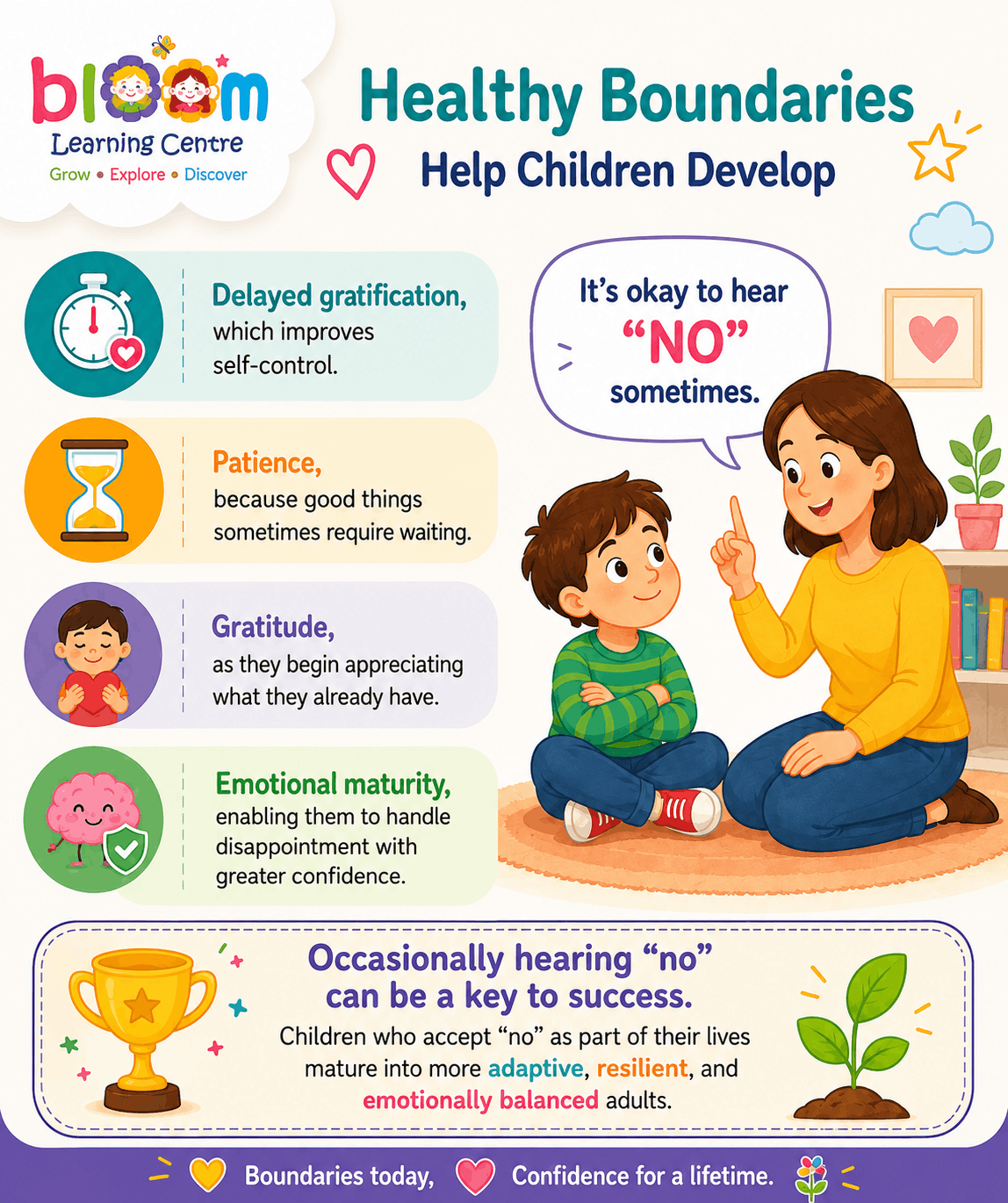
At Bloom Learning Centre, children naturally encounter situations that require them to wait, take turns, share resources, and respect others' needs.
These everyday interactions become powerful lessons in life.
Our educators gently guide children through moments of disappointment instead of immediately removing the challenge. Whether it's waiting patiently for their turn during an activity, sharing toys with classmates, or accepting that everyone cannot always be first, children gradually learn to regulate their emotions with confidence.
Rather than avoiding difficult emotions, we help children understand that,
At Bloom, we believe emotional resilience grows not from giving children everything they want, but from helping them discover they are strong enough to handle life's small disappointments with grace and confidence.
Childhood is a phase when curiosity and creativity build each day. Parents, out of natural love, want to solve every problem the child faces.
However, in most cases, children don't need immediate solutions. What they need is someone who is genuinely concerned and listens to them without being judgmental.
Children haven't seen the world yet. They appreciate an approach where every conversation doesn't have instructions, corrections, or life lessons. If parents continue doing so, children may gradually stop sharing their thoughts and views. One fine day, they might not even open up where necessary. As a result, children start believing that their feelings, emotions, and views have no importance in finding the "right" answer.
Too much advice can make children doubt their own abilities. They gradually stop thinking and responding to a situation.
Providing emotional support is the best gift to your children. Making them feel emotionally safe will help them flourish.
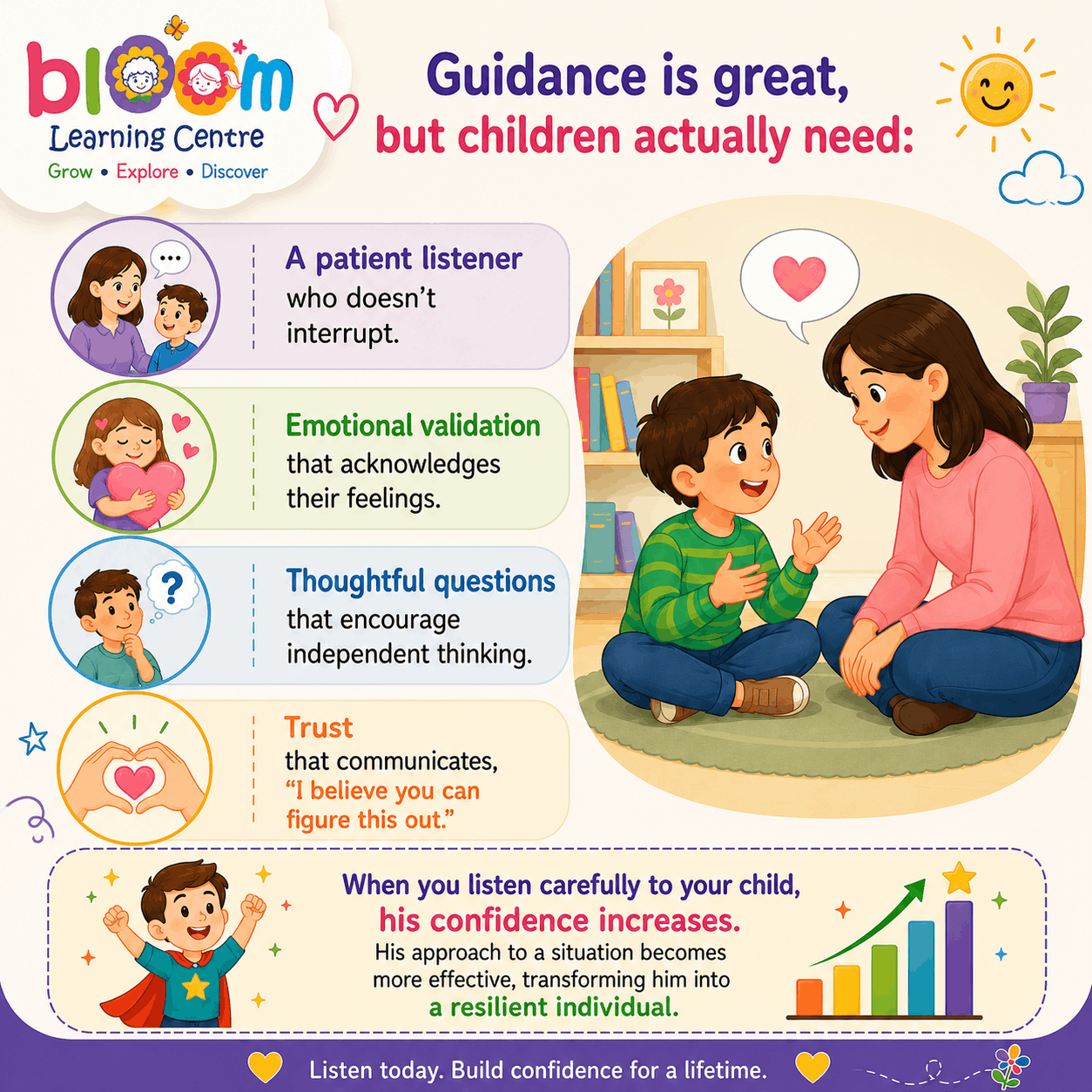
Meaningful conversations can make the right difference and strengthen the bond with children. You don't need to offer an immediate solution.
Instead of offering a solution, try giving space to your child. Begin by asking questions like:
"What do you think happened?"
"How did that make you feel?"
"What do you think you could try next time?"
These simple and subtle questions will encourage your child to think about the problem or the situation. This process will not only boost his confidence, but also sharpen his problem-solving skills. The parent-child bond will elevate to the next level.
When children have the assurance that they won't be judged or lectured, they feel relaxed and emotionally calm. Now they know when to respond to a situation and when to seek guidance from their parents. This clarity makes them think clearly, develop a better vision, and consider various perspectives to fetch a suitable solution, and honestly, most parents want this to happen.
Meaningful conversations are woven into daily learning at Bloom Learning Centre.
Our educators intentionally foster a nurturing environment where every child feels heard, respected, and valued. Whether children are sharing exciting discoveries, expressing frustrations, or discussing friendships, we provide them with the time and emotional space to communicate openly.
Instead of giving immediate answers, we encourage children to express their thoughts, explore different perspectives, and arrive at solutions through guided discussions.
These conversations strengthen communication skills, critical thinking, self-confidence, and emotional intelligence, preparing children to be thoughtful communicators throughout their lives.
At Bloom, we don't just teach children to speak. We help them build the confidence to express themselves, listen to others with empathy, and build meaningful relationships.
Offering emotional support to your child is the greatest gift, but that doesn't mean that parents get the right to control every aspect of their child's life.
On the contrary, parents should support their child's journey, celebrate their progress, and be present when the child needs reassurance and support. Don't compel the child to depend on you. Instead, let them have a free hand at making age-appropriate choices and decisions. Instead of suggesting directly, help your child learn through his own experience. The bond between parents and children is about love, understanding, and trust. So always trust your child and make him feel that: "I believe in you."
It makes less sense to instruct children simply. Instead, parents should model while children observe them closely.
Parents can practice responding appropriately to stress, setbacks, disagreements, and uncertainty. Your actions become your child's emotional blueprint that they will never forget.
Staying calm in difficult situations is tough. But parents can practice staying calm during difficult moments and let children learn that panic isn't the only response to challenges. Difficult moments can easily be tackled with a calm mind and strong determination. Demonstrating emotional stability at home creates emotional security in children.
Every individual is unique and has equally unique dreams.
Children make their choices clear from the beginning. Some may love art, while others enjoy science, music, sports, storytelling, or problem-solving. Along with individual skills, each child has their own way to approach things. Even while children are an extension of their parents, they need not have the same dreams as their parents. Hence, parents should avoid placing the weight of their own unrealized dreams on the shoulders of their child.
To bring out the best in your kid, nurture his curiosity and creativity. Allow your child to explore this world in his unique way. Never just count on the results; effort is more important, as they pave the real path to the child's success.
Parents are the child's best friends and well-wishers. But in the race to grab success, they start taking decisions on the child's behalf. What happens when your child makes his own choice? The child's confidence grows with every effort he puts in to achieving his goal.
By offering the child the opportunity to make age-appropriate decisions, he receives two gifts. If his decision becomes correct, he tastes success, but if the decision goes wrong, he learns a valuable lesson. In either case, the child benefits.
Start with a simple exercise. Place two healthy snacks before the child and ask him to choose between them. Let them choose the book to read today, or select the clothes they want to wear for a weekend picnic. As your child matures, you can gradually increase the responsibility behind every decision he makes. In this way, you are preparing him to take on tomorrow's responsibility.
Guidance is important and offers it when asked for.
Do understand that your child hasn't seen the world yet. Hence, he would naturally seek guidance from a person who makes him feel safe. When you can always help your child excel in whatever he does, it is advisable to become his trusted companion, then a constant critic.
When children know they can share their thoughts without fear of criticism, they develop deeper trust, stronger communication skills, and lasting emotional security.
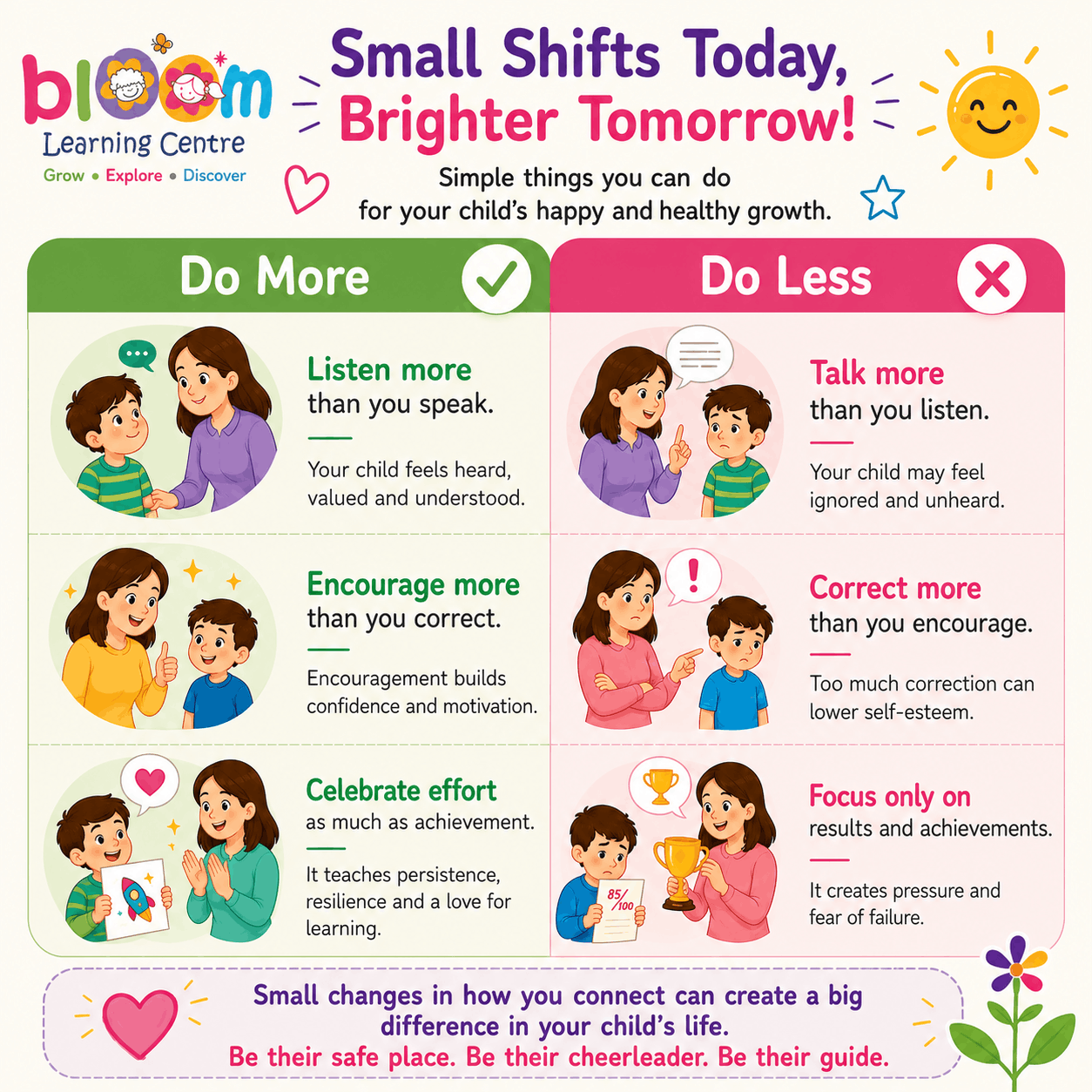
At Bloom Learning Centre, we believe childhood is not a race to accumulate academic achievements. It is a journey of discovering confidence, compassion, curiosity, and character.
Our play-based learning environment is thoughtfully designed to nurture the whole child, not just their cognitive abilities. Every classroom experience encourages children to think independently, solve problems creatively, communicate confidently, and build meaningful relationships with those around them.
From collaborative group activities and imaginative play to age-appropriate responsibilities and guided conversations, each interaction helps children build the life skills they will carry into adulthood.
Equally important, we believe parents and educators are partners in a child's development. Through open communication and shared values, we collaborate to create an environment in which children feel supported, respected, and inspired to become their best selves.
At Bloom, our goal is not simply to prepare children for school, but to prepare them for life.
Parenting is one of life's most meaningful journeys, and like every journey, it brings moments of learning, reflection, and growth.
No parent is perfect, and mistakes are inevitable. What truly matters is the willingness to recognize them and to make thoughtful changes along the way.
As children grow, our role gradually shifts from doing everything for them to empower them to do more for themselves. Every responsibility we entrust to them, every thoughtful boundary we set, every meaningful conversation we have, and every opportunity we give them to solve their own challenges helps shape the confident, compassionate, and resilient individuals they are becoming.
Remember, the goal of parenting is not to shield children from every obstacle. It is to equip them with wisdom, courage, and emotional strength to overcome those obstacles on their own.
At Bloom Learning Centre, we are honored to partner with parents on this beautiful journey. Together, let's nurture children who are confident enough to think independently, resilient enough to embrace challenges, and compassionate enough to leave the world a little better than they found it.
Because the greatest measure of successful parenting is not how much our children need us tomorrow, but how confidently they can stand on their own.
Are you eager to help your child grow into a confident, compassionate, and capable individual? Visit Bloom Learning Centre and discover how our realistic and play-based approach empowers children with the skills they need for academics, life, and beyond. We'd love to be part of your family's parenting journey.