
Communication has always remained essential since humanity came into existence on this earth. May it be signs, symbols, or actual words and phrases, language has always been an integral channel for communication.
A child's language journey begins much earlier than the first complete sentence it speaks. From the very beginning, their brains start absorbing sounds, words, emotions, and expressions. They also start recognizing familiar voices and sounds, and that is where every smile, giggle, conversation, and response starts giving shape to the child’s communication foundation.
Many parents feel that child language development is too difficult. Hence, we need expensive educational toys or structured lessons to improve our child’s language development. This is a myth that most parents have, but the truth is much simpler than you can imagine.
You already have the most prominent, most promising learning tool called "meaningful conversations" available at your home.
Just think of scenarios where:
These are not just scenarios. There are real opportunities to interact and strengthen language skills in children.
Aren’t these opportunities a real playground for your child to learn far more than vocabulary? This is the magic that everyday conversation brings into your child’s life. With gradual progress, children develop confidence, curiosity, and emotional awareness. They also develop the ability to express their thoughts, views, and opinions clearly.
Remember that positive parent-child communication always creates an excellent environment within the family. Besides building a stronger relationship with your smart kid, positive communication and responses make children feel heard, valued, and understood. That is the right instance where your child starts building his confidence and self-trust.
Offering a language-rich environment to your little wizard doesn't require you to be perfect. All you need is a gentle start where your child talks, listens, and connects with you every single day.
Words are more powerful than weapons. So, use them wisely today to shape your child’s communication tomorrow.
Talk, Talk, Talk ...
Early language development happens during the first six years of your child’s life. It is during this crucial period that the child’s brain rapidly creates neural connections.
These neural connections are essential for the development of pathways like speech, understanding, memory, and learning. Every time you communicate with your child, these pathways become stronger, enhancing the level of communication, making it easier and more natural in the long run. It is more than necessary to engage your child in talking with you and other family members.
Learning a language is a continuous process, and adding new words to your child’s vocabulary requires consistent conversations. Parents are the first teachers of a child. Introduce your little champion to new and simple words. Help him try different sentence patterns and richer expressions while speaking.
Vocabulary development is essential during these early years. When children are better equipped with relevant words, they can easily describe their thoughts and feelings, ask questions, and share their ideas. You might come across situations when your kid might impress and mesmerize you with their eloquent dialogues and creative expressions.
Responsive conversation is an important element of every successful communication. Parents must teach children that communication is a two-way process. It means that when parents speak, children need to listen, think, and respond or reply appropriately. Likewise, parents need to listen to their child, respond thoughtfully, and encourage further discussion. Children must learn that their opinions do matter.
The effectiveness of responsive conversation solely depends on the strength and accuracy of communication skills in children. Allow your child to open his heart before you. Never interrupt or nag while the child is speaking. Never focus on his erroneous sentence construction; appreciate his efforts. Increase his confidence by helping him participate actively in conversations at home, school, and beyond.
Simple exchanges of words, no matter how brief they might be, are pivotal in your child’s communication journey. Allow them an opportunity to develop their ability to communicate effectively.
You don't need a classroom at home. Your kitchen is a great place to create Little Chatterboxes.
Think for a while: does your child really need special learning sessions for their language growth? In reality, small daily moments are enough to build strong language skills in them. As a modern-day parent, you do have the power to transform ordinary daily routines into valuable language learning activities. Why not give it a try today?
Ask your child to come over. Make him sit and start describing your cooking tasks. Begin by naming ingredients, colors, shapes, and actions. Continue the same while getting dressed. Talk about clothing, weather, and textures.
Grocery stores are the best place to take your child. Ask your kid to identify fruits, vegetables, numbers, or colors. Possibly accommodate your toddler in the shopping cart while you browse the racks. Explain the buying process in an easy-to-understand manner to your child. Use location-specific vocabulary. It is through these simple everyday conversations with children that you can help them explore new vocabulary in familiar settings.
Outdoor walks offer fantastic learning opportunities for children. Begin with birds flying overhead. Talk about their size, color, and the lovely sounds they make. Stand at a safe distance while showing them passing vehicles. Start with naming the vehicle, its shape, color, and use.
Talking about changing weather, blooming flowers, or natural sounds of wind or rain can also create a comfortable setting to communicate with your toddler. With such a variety, children naturally become curious about various subjects when adults describe the world around them.
Family mealtimes are a favorite for most households. Kids look forward to such an excellent opportunity for language development at home. Focusing on screens is a pure distraction; avoid them. Everyone in the family can take turns sharing their stories about how their day went. They can also talk about their favorite moments they experienced and exciting discoveries they made.
Bedtime stories are a great way to enhance their language skills. Inspire your child to talk about what made them happy, surprised, or curious during the day.
These short-looking discussions are capable of leaving lasting impressions and strengthening language skills in children. These simple daily moments can fetch amazing results when used strategically to build strong language skills in children.
The atmosphere at home plays a vital role in determining how confidently children express themselves. It all begins with the way parents communicate with their children. It is essential to keep the home environment light and positively charged. Making small changes to daily conversations can bring about a significant difference, encouraging children to share their thoughts and views.
When you truly want your child to talk at length, switch to asking open-ended questions. Asking questions that end with "yes" or "no" as an answer won't serve the purpose. Parents can use open-ended questions like "What was your favorite part of today?" or "How did you build that tower?" to start their communication. This naturally encourages children to speak more freely and confidently.
Language development is a scientific process. Read our blog to have an in-depth understanding of the stages of language development in children.
Never expect your child to answer immediately to your open-ended question. A decent approach is to allow them enough time to think before responding. Let them understand the question, apply their intellect, and provide a well-thought-out answer. If your child goes silent for a while, it isn't a problem. On the contrary, your child is organizing his thoughts, gathering words, and choosing the right ones to respond.
Listening patiently and carefully to your child is the best gift you can give them. See the smile and satisfaction on their face when you listen to them without interrupting their sentences. This behavior will automatically earn you ample respect. Respecting your child is more valuable than you can imagine. It is this respect that motivates them to participate in future conversations without fear.
Instead of just correcting your child’s responses, you can also complement them. If your child says, "Big dog," you might reply, "Yes, that's a huge brown dog running very fast." In this way, you will not only be talking with your child but also introducing him to a richer vocabulary naturally.
Eye contact plays a crucial role. Proper eye contact with a warm smile and genuine interest helps your child feel secure and comfortable while replying. It is too early for your little champion to master his pronunciation.
Instead, celebrate every communication attempt to show that his words have value.
Following these simple habits will gradually improve communication skills in children. Their conversations will soon become enjoyable and stress-free.
Childhood is a once-in-a-lifetime experience that will never return. So, parents should make their kids’ childhoods memorable by becoming one like them.
Books are a treasure house of knowledge. They open doors to words, phrases, and ideas that children need for everyday conversations. Knowing how to use each word and phrase efficiently helps your child communicate confidently with people around. Ask children to read aloud. This practice will not only strengthen their vocabulary and listening skills but also enable them to master sentence structure and comprehend it effectively.
Reading the same story once or twice to your child will help him remember it. But doing this repeatedly will enable the child to learn and memorize new words, understand their meanings, and use them in their own sentences. That’s the exact reason why reading to children remains one of the most effective ways to build language skills even today.
Did you know that songs and nursery rhymes add a new flavor of joy and an essential layer of learning to your child’s life? These songs and nursery rhymes are written in a way that their rhythm and repetition enhance the power of pronunciation, memory, and speech patterns, delivering an enjoyable learning experience to your kid.
Creative storytelling has many great benefits. Storytelling for kids triggers imagination and creativity in children. Pick up a new story for your child; read it completely. Now, invite your child to listen to that new story. Once you are halfway, ask your child to predict what happens next.
You can also ask them to create their own ending to a story. Now share the real ending of that story and ask your kid which ending was better. If you practice this approach, your child will develop his creativity and begin imagining better endings. Making this a regular practice enhances the child’s sequencing skills and makes him an expert at using descriptive language.
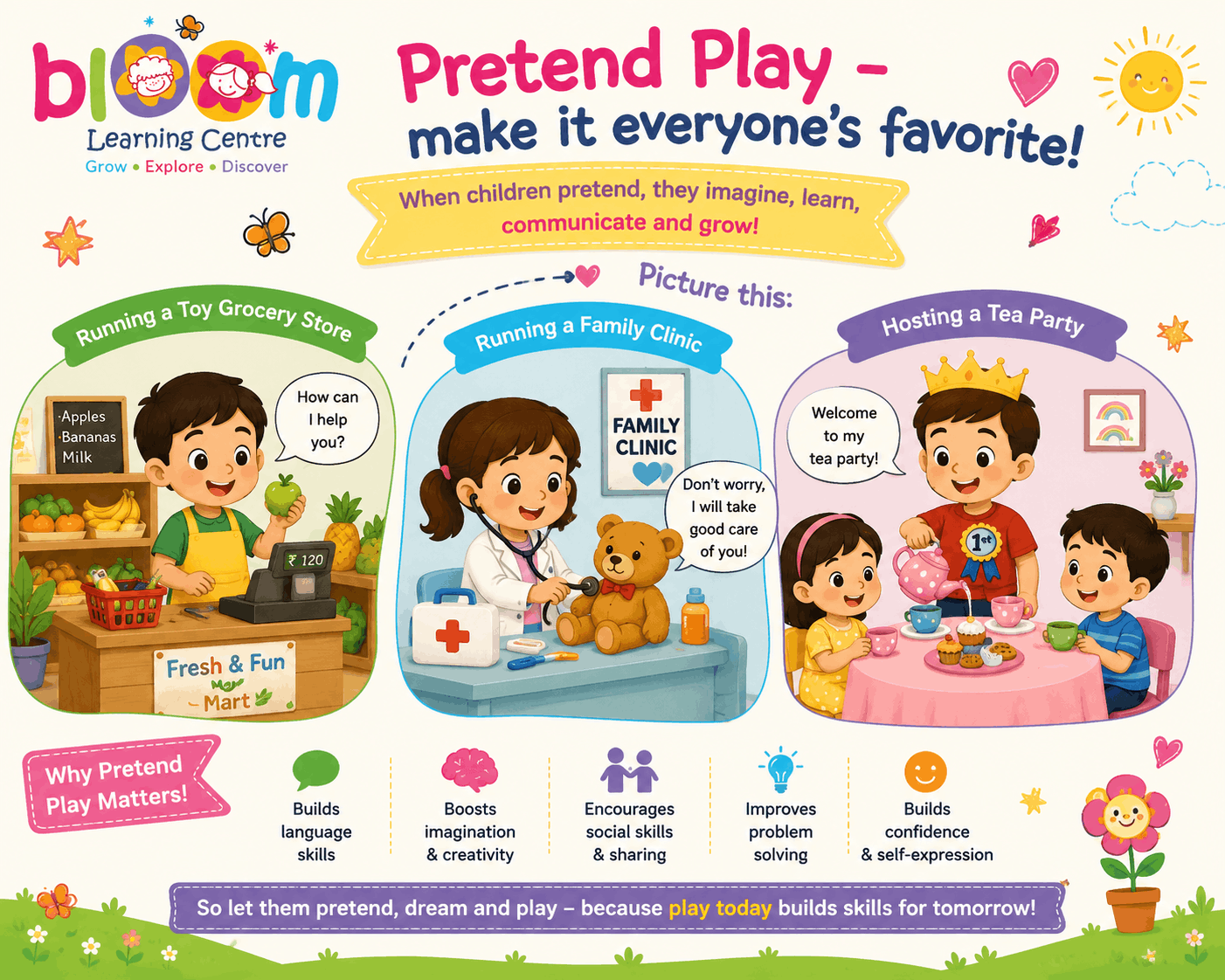
In the above scenarios, your child can engage in conversations, ask questions, solve problems, and suggest solutions. These tiny props can foster language development through play in children. With the support of their parents and other family members, children can practice communication in a relaxed and enjoyable environment.
Repeated exposure to stories, songs, and imaginative play builds confidence while encouraging children to ask questions, explain their thoughts, and communicate more effectively.
While it is true that your child doesn’t require complicated methods to develop strong communication skills, certain everyday habits may slow down your child's progress.
When the child feels bored, parents allow them to spend time with digital screens. It might be unintentional, yet excessive screen time can become the biggest hurdle in the child’s language development journey.
Educational videos can offer exposure to new words; nevertheless, viewing a screen passively cannot replace real conversations. Most children are curious; hence, they keep asking questions. These questions are the best gateways to learning new words and acquiring new knowledge. It is this curiosity that motivates children to await the best possible responses from their parents and from people around them.
Life will give you ample opportunities to correct your child’s pronunciation or grammatical errors. Nagging and interrupting their conversations make children unhappy. They eventually become hesitant to speak or share their thoughts. A gentle approach is to acknowledge what they are trying to say. Once they complete speaking, you can model the correct words as part of this conversation. To achieve your purpose, stick to these simple speech development tips. Let your child learn without feeling discouraged or disheartened.
Similar Blog: Powerful Strategies To Encourage Speech Development In Children
When visiting friends or relatives, do you speak on behalf of your child?
If you are doing so to save time or avoid awkward situations, you are making a big mistake. You are compromising your child’s confidence and limiting opportunities for him to communicate independently. You were never meant to do this.
Go ahead and allow them to answer questions, place an order, or introduce themselves to your relatives and friends – have trust in your nurturing.
With the kind of life we are exposed to, it becomes difficult to have meaningful conversations regularly.
Try this today: Provide your kid with a few uninterrupted minutes during meals, bedtime, or car rides. The lasting difference it creates will surprise you for sure.
Children are naturally curious. When you repeatedly ignore their questions, they feel hurt and ignored and stop asking questions altogether. Even if you are stressed professionally or burnt out because of household responsibilities, your patience can bring peace. Hence, respond patiently. This attitude will maintain the child’s curiosity and confidence while elevating his communication capabilities to the next level.
Finally, achieve more smartly. Provide your child with regular social experiences. They will prepare him to overcome many language development challenges naturally.
Every child is unique and different. Hence, each child masters language skills in their own special way. It is true in every society that some children begin speaking early, while others take more time to utter their first word.
This diversity is universal. Hence, parents must avoid worrying unnecessarily about language milestones. Every child is an extension of their parent’s DNA, yet they still have their own individuality. So it isn’t sensible enough to compare your kid with his siblings, cousins, or classmates. By doing so, you might unknowingly create pressure on their tender mind. Comparing your child with others will never open paths to improvement. Try focusing on steady improvement while celebrating every new word or sentence they speak, or conversation they have.
Maintaining patience in the family can have a magical effect. Patience offers a solid foundation for healthy speech and language development. Children thrive and stay happy when they feel supported by their parents. While judging your child seems easy, offering encouragement to learn new things, acknowledgement for their efforts, and reassurance for the (innocent) mistakes they made is equally difficult.
A word of caution:
If you see delays in communication over time or your child consistently finds it difficult to understand or express himself, you should definitely seek early professional help. Support in time can help children overcome challenges before they compromise their learning, confidence, and self-trust.
Your kid is special; hence, he deserves a nurturing environment filled with love, encouragement, and meaningful conversations. Such an atmosphere facilitates children’s communication development. Help your kid flourish at a pace that’s right for him.
At Bloom Learning Centre, language learning is woven naturally into every child's day instead of being limited to formal lessons. Through engaging play-based learning, children participate in storytelling sessions, songs, role play, group discussions, and interactive games that encourage them to communicate confidently. These enjoyable experiences expose children to rich vocabulary while making learning feel effortless.
Our teachers carefully create opportunities for conversation during classroom and outdoor activities. Whether children are working together on a project or sharing ideas during circle time, teachers encourage them to listen, speak, ask questions, and express themselves respectfully. With every passing day, children build their self-trust.
Recognizing that every child learns differently, Bloom provides personalized guidance to meet individual communication needs. This thoughtful approach strengthens preschool language development, helping children gain confidence at their own pace.
The classrooms we provide are warm, safe, and encouraging. They allow children to feel confident and speak without fear of making mistakes.
Bloom believes in partnering closely with parents by sharing practical strategies that continue early childhood education at home. Together, this partnership creates a strong foundation for lifelong communication and learning.
Supporting your child's communication is simple and easy. You don't need to make dramatic changes. Simply apply the following small daily habits to obtain great results.
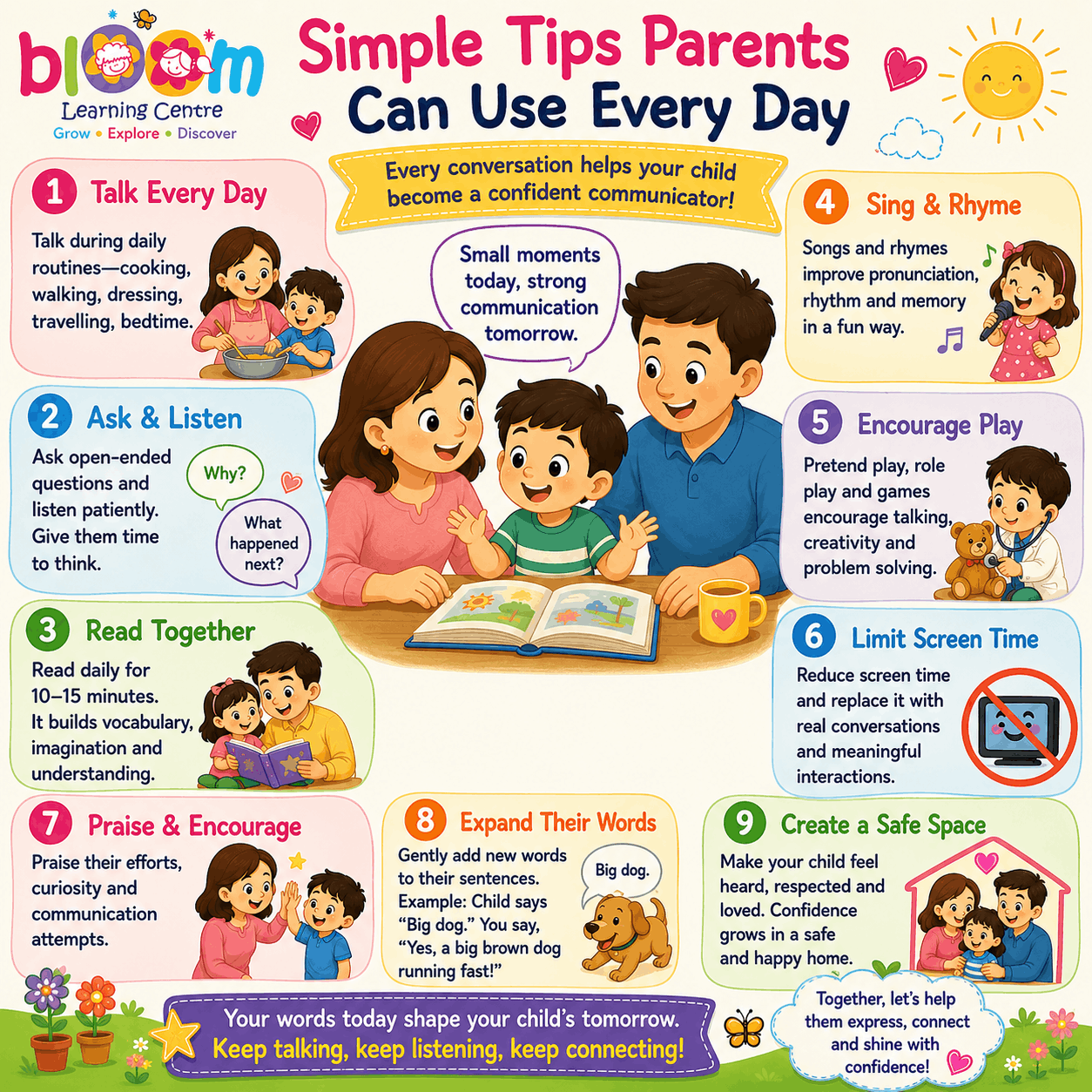
Every conversation you have with your child is an investment in their future. A kind word, an interesting question, or a patient response helps build strong communication skills that will benefit them throughout life.
Language development doesn't happen overnight. It grows naturally through consistent conversations, shared experiences, and meaningful interactions. The small moments you create today become the building blocks of tomorrow's confidence.
Parents remain a child's first and most influential teachers. By making communication a joyful part of everyday life, you help your child become a confident communicator for tomorrow.
With a nurturing home environment and expert language development support from Bloom Learning Centre, every child can develop the communication skills needed to succeed in school, build healthy relationships, and thrive in the future.
Learning begins at birth. Babies start learning languages by listening to familiar voices, observing facial expressions, and experiencing everyday conversations.
There's no set duration. Simply include your child in frequent, natural conversations during daily routines such as meals, playtime, walks, and bedtime.
Yes. Reading aloud builds vocabulary, strengthens listening skills, improves sentence comprehension, and sparks imagination. Interactive reading makes the experience even more effective.
Yes. Excessive passive screen time reduces valuable face-to-face conversations. Real human interaction remains the most effective way to develop strong communication skills.
Bloom nurtures language skills through play-based learning, storytelling, songs, conversations, role-play, and personalized guidance, helping every child become a confident communicator in a caring environment.